Why Softer Water Can Make a Bigger Difference at Home Than You Think
Water is one of those everyday things we rarely question. We wash dishes with it, shower in it, make coffee with it, and fill the washing machine without giving much thought to what’s actually coming through the pipes.
Then the little annoyances start adding up. A cloudy glass here. A crusty faucet there. Soap that doesn’t seem to rinse properly. Maybe your shower leaves your hair feeling dry, even after switching shampoos twice.
In many homes, hard water is behind at least some of these frustrations. It isn’t usually a dramatic problem, but over months and years, mineral-rich water can affect plumbing, appliances, cleaning routines, and even how water feels against your skin.
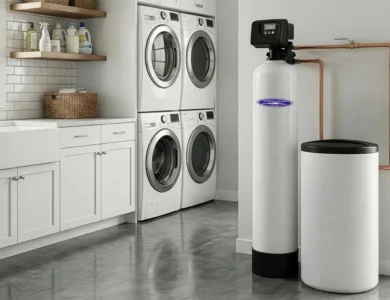
That’s where water softening can become useful. Not as a magic fix for every water concern, but as a practical way to make everyday household water easier to live with.
What Hard Water Is Actually Doing
Hard water contains higher levels of minerals, mainly calcium and magnesium. These minerals are naturally picked up as water travels through rocks and soil, especially in groundwater sources.
You can often spot the signs without a laboratory test. White spots appear on glasses. Faucets develop chalky deposits. Showerheads become clogged. Soap doesn’t lather quite the way you’d expect.
The effects can also happen where you can’t see them.
Inside water heaters, mineral deposits can accumulate on heating elements. In plumbing fixtures, scale can gradually restrict water flow. Appliances that regularly heat water may be particularly affected.
This doesn’t mean hard water is automatically unsafe. Rather, it can be a persistent household nuisance that becomes more expensive to ignore over time.
Your Appliances May Be Feeling It Too
Think about how many appliances use water every week: the dishwasher, washing machine, water heater, coffee maker, and sometimes an ice maker or humidifier.
Repeated exposure to hardness minerals can contribute to scale inside water-using equipment. Over time, that buildup can make appliances work harder and may increase maintenance requirements.
Protecting appliance life is one reason homeowners consider water softening. Reducing the minerals responsible for scale can help limit future deposits in equipment and plumbing.
Of course, a softener doesn’t guarantee that an appliance will last forever. Maintenance, water temperature, usage patterns, and product quality all matter. Still, reducing one source of wear can be a sensible part of broader household maintenance.
It’s a bit like changing the oil in your car. It doesn’t make the engine immortal, but you wouldn’t skip it and hope for the best.
Softer Water Can Change the Shower Experience
The shower is often where homeowners notice softer water most quickly.
Hard water can interact with soaps and shampoos, making them harder to rinse completely. Mineral residue may remain on the skin or hair, leaving a rough or coated feeling.
Some people report softer skin and hair after switching to softened water, particularly when their previous water was very hard. Softer water can also make soap and shampoo lather more easily, meaning you may need less product to get the same effect.
That said, everyone’s experience is different. Skin and hair are influenced by climate, products, washing frequency, and personal sensitivity. Water softening shouldn’t be treated as a guaranteed beauty treatment.
Still, if your shower has always left you feeling like you need another rinse, water hardness may be worth investigating.
Cleaning Can Become Less Frustrating
Hard water has a talent for making simple chores feel strangely difficult.
You clean a sink, and a day later there are white marks again. You wash a glass, hold it up to the light, and there are spots everywhere. The shower door looks clean until sunlight hits it.
Softened water can reduce the minerals that contribute to these deposits, which may make routine cleaning easier.
You may also find that soap performs better. Without as much calcium and magnesium interfering with the lathering process, detergents can work more efficiently.
This doesn’t mean your cleaning routine disappears. Unfortunately, the bathroom fairy isn’t coming. But you may spend less time fighting mineral residue.
Choosing a System Isn’t One-Size-Fits-All
The right water softener depends on several factors.
Household size is one. A home with two people generally has different water demands than a home with six.
Water hardness matters, too. Testing your water gives you a clearer idea of how much treatment capacity you’ll need.
Then there’s water usage. Some systems regenerate based on a schedule, while others use demand-based controls to regenerate according to actual consumption. More efficient systems can potentially reduce unnecessary salt and water use.
Installation space, budget, maintenance requirements, and local service availability should also be considered.
A system that looks perfect online might not be ideal once it meets the realities of your basement, utility room, or plumbing layout.
Why Personalized Advice Can Be Helpful
There’s no shortage of water-treatment information online. That’s useful, but it can also get confusing quickly.
One website recommends a particular capacity. Another says you need something larger. A third insists that a completely different technology is the answer.
That’s where personalized recommendations can be valuable — provided they’re based on actual water conditions rather than simply a sales target.
A professional should ideally ask about your water source, hardness level, household size, water consumption, existing plumbing, and the specific problems you’re trying to solve.
The goal shouldn’t be to sell you the most complicated system available. It should be to find equipment that makes sense for your home.
Don’t Forget Maintenance
Water softeners aren’t completely hands-off.
Salt-based systems need regular salt replenishment, and the system should be checked periodically. Resin and control components can eventually require servicing. If the equipment isn’t maintained properly, performance can decline.
Before buying, find out how often maintenance is expected and what replacement parts cost.
Also ask about warranties and service availability. A system is easier to live with when you know where to turn if something stops working.
Long-term convenience matters just as much as installation day.
Is Softened Water Worth It?
For households with significant hard water, it can be.
The benefits aren’t always dramatic or flashy. They’re often small improvements that accumulate: fewer mineral spots, easier cleaning, better soap performance, less scale inside plumbing and appliances, and a more pleasant shower.
If your water is only mildly hard, you may decide the investment isn’t necessary. That’s perfectly reasonable. Testing gives you the information needed to make that call.
The important thing is to avoid buying equipment simply because someone says every home needs it.
A Small Change That Can Make Daily Life Easier
Good home improvements don’t always have to be visible. Sometimes the best upgrades are the ones quietly working behind the scenes.
A properly selected water softener can help reduce the everyday frustrations associated with hard water while supporting cleaner fixtures, more efficient household routines, and better protection for water-using equipment.
Start with a water test. Understand the level of hardness. Think about how much water your household actually uses, then compare systems based on capacity, efficiency, maintenance, and long-term cost.
You don’t need the biggest system or the fanciest features.
You just need one that fits your home and does its job well. And honestly, when you turn on the shower or wash a glass and everything simply feels a little easier, that’s a pretty worthwhile improvement.